JAMB Economics 1983 past questions
49 real JAMB UTME Economics questions from 1983, with answers. Here are 5 to try; tap “Show answer” to check yourself.
Which of the following items is NOT included in measuring national income by the income approach?
- A. Wages and salaries of public servants
- B. Student grants and scholarships.
- C. Profits of companies.
- D. Income earned by self employed persons such as lawyers.
- E. Rents on property.
Show answer
Answer: B — Student grants and scholarships are transfer payments, not payments for productive services.
A down ward sloping demand curve intersects a fixed supply curve. A shift of this demand curve to the right implies that
- A. both price and quantity will increase
- B. only price increase
- C. only quantity increase
- D. the price remains constant
- E. the price falls.
Show answer
Answer: B — With a fixed (vertical) supply, a rise in demand raises only the price.
Which of the following items is NOT an argument for locating industries in rural areas?
- A. Rural areas supply agricultural raw material.
- B. The pace of development will be quickened in rural areas.
- C. Employment will be provided for rural inhabitants.
- D. Capital is easily available in rural areas.
- E. Suitable humid climate is sometimes found in rural areas.
Show answer
Answer: D — Capital is scarce, not easily available, in rural areas.
Study the diagram shown. The curves D₀D₀ and S₀S₀ are the demand and supply curves respectively. What happens if the government subsidizes producers in order to boost output?
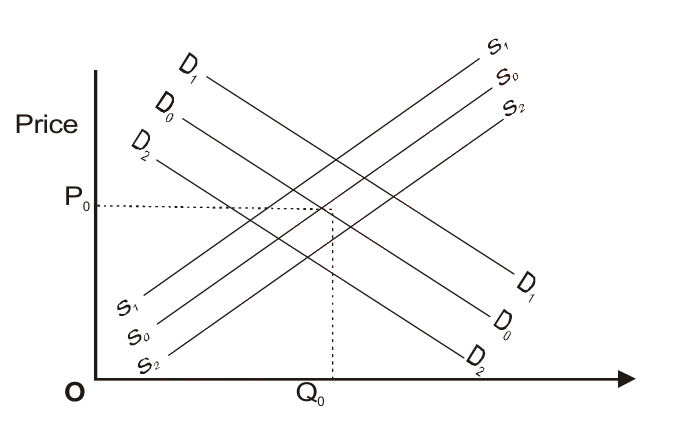
- A. The supply curve will shift S0S0 to S2S2
- B. The supply curve will shift from S0S0 to S1S1
- C. The supply curve will shift from S2S2 to S1S1
- D. The supply curve will shift from S1S1 to S0S0
- E. The demand curve will shift from D0D0 to D1D1
Show answer
Answer: A — A subsidy lowers costs, shifting supply to the right: from S₀S₀ to S₂S₂.
The natural growth rate of a population is the
- A. Sum of the birth rate and the death rate
- B. Sum of the birth rate and the net migration rate
- C. Birth rate minus the death rate
- D. Birth rate divided by the net migration
- E. Death rate minus the net migration.
Show answer
Answer: C — Natural growth rate = birth rate − death rate.
Practise all 49 questions in a real CBT
Timed like the real exam, with an AI tutor that explains every answer step by step.
Start practising free Already a student? Open this paper