JAMB Chemistry 1997 past questions
50 real JAMB UTME Chemistry questions from 1997, with answers. Here are 5 to try; tap “Show answer” to check yourself.
35 cm³ of hydrogen was sparked with 12 cm³ of oxygen at 110 °C and 760 mmHg to produce steam. What percentage of the total volume of gas left after the reaction is hydrogen?
- A. 11%
- B. 31%
- C. 35%
- D. 69%
Show answer
Answer: B — 12 cm³ O₂ uses 24 cm³ H₂, leaving 11 cm³ H₂ with 24 cm³ of steam: 11/35 = 31%.
2.85 g of an oxide of copper gave 2.52g of copper on reduction and 1.90 g of another oxide gave 1.52 g of copper on reduction. The data above illustrates the law of
- A. constant composition
- B. conservation of mass
- C. reciprocal proportions
- D. multiple proportions.
Show answer
Answer: D — Per gram of copper, the oxygen masses (0.131 g and 0.25 g) are in a simple ratio of about 1 : 2.
A sample X, solid at room temperature, was melted, heated to 358 K and allowed to cool, as shown by the curve OPQR in the graph. The flat section PQ indicates that X is
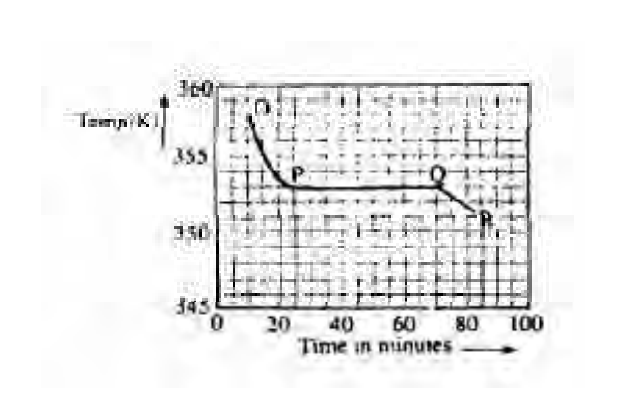
- A. a mixture of salts
- B. a hydrated salt
- C. an ionic salt
- D. a pure compound
Show answer
Answer: D — A sharp, constant freezing point shows a pure substance.
From the same cooling curve (OPQR), the section OP suggests that X is in the
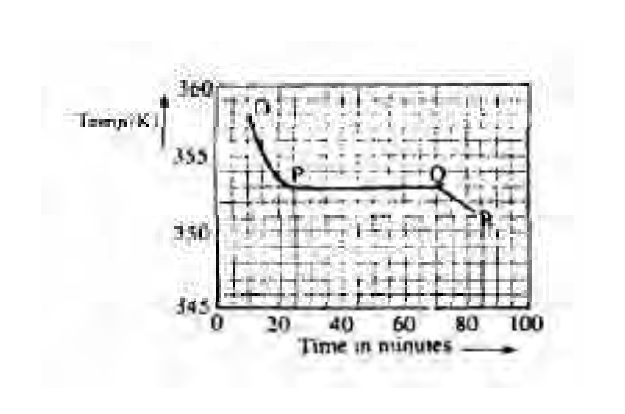
- A. liquid state
- B. solid/liquid state
- C. solid state
- D. gaseous state
Show answer
Answer: A — Before freezing begins at P, X is a cooling liquid.
An element X forms a volatile hydride XH₃ with a vapour density of 17.0. The relative atomic mass of X is
- A. 34.0
- B. 31.0
- C. 20.0
- D. 14.0
Show answer
Answer: B — Mr = 34, so X = 34 − 3 = 31.
Practise all 50 questions in a real CBT
Timed like the real exam, with an AI tutor that explains every answer step by step.
Start practising free Already a student? Open this paper