JAMB Chemistry 1985 past questions
49 real JAMB UTME Chemistry questions from 1985, with answers. Here are 5 to try; tap “Show answer” to check yourself.
The figure shows part of the Periodic Table with some elements lettered. Which of the elements belong to the p-block?
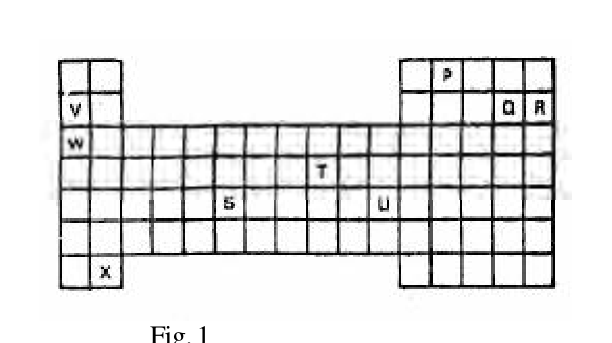
- A. S, T and U
- B. V, W and X
- C. S and T only
- D. P, Q and R
- E. V, W, X and S
Show answer
Answer: D — P, Q and R are in the block of six groups on the right: the p-block.
Which of the following conducts electricity?
- A. Sulphur
- B. Graphite
- C. Diamond
- D. Red phosphorus
- E. Yellow phosphorus
Show answer
Answer: B — Graphite has delocalized electrons.
An organic compound contains 72% carbon, 12% hydrogen and 16% oxygen by mass. The empirical formula of the compound is [H = 1, C = 12, O = 16]
- A. C₆H₂₂O₃
- B. C₆H₁₀O₃
- C. C₁₂H₁₂O
- D. C₆H₁₂O
- E. C₃CH₁₀
Show answer
Answer: D — C : H : O = 6 : 12 : 1.
0.499 g of CuSO₄·xH₂O when heated to constant mass gave a residue of 0.346 g. The value of x is [Cu = 63.5, S = 32.0, O = 16, H = 1]
- A. 0.5
- B. 2.0
- C. 3.0
- D. 4.0
- E. 5.0
Show answer
Answer: D — 0.346 g CuSO₄ = 0.00217 mol; 0.153 g water = 0.0085 mol: x ≈ 4.
In an experiment, which of the following observations would suggest that a solid sample is a mixture? The
- A. solid can be ground to a fine powder
- B. density of the solid is 2.25 g cm⁻³
- C. solid begins to melt at a lower temperature and finishes melting at 648 K
- D. solid absorbs moisture from the atmosphere and turns into a liquid
- E. solid melts at 300 K
Show answer
Answer: C — A mixture melts over a range of temperature. Note: Option C is printed "solid begins to melt until 648 K" in the book.
Practise all 49 questions in a real CBT
Timed like the real exam, with an AI tutor that explains every answer step by step.
Start practising free Already a student? Open this paper